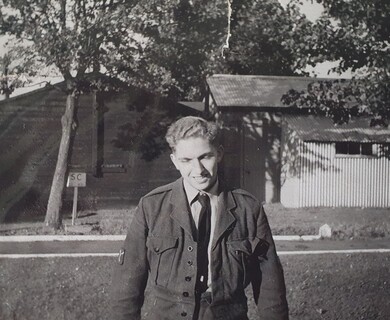
Back to: SingSurf home page Derek Morris
Notes for a talk given to the Harpenden Probus group in 2021
National Service has been used in many countries for over 100 years as a method of conscripting men, and sometimes women, into the armed forces.
In the UK from 1949 to 1950 NS was limited to healthy men aged 17 to 21 who served for a period of 18 months, and then had to remain on the reserve list for four years. There were three exempt “essential services” coal mining, farming and the merchant navy, but one had to serve eight years in these industries to escape NS.
In October 1950 the service period was extended to two years because of the British involvement in the Korean War. NS men were also involved in combat in Malaya, Cyprus and in Kenya against the Mau-Mau.
NS ended gradually from 1957 and the last men entered service in November 1960.
It seems possible that in 10 years or so there will be very few of left who can talk about our time serving in National Service. So even if our memories are growing dim it seemed a good idea to get together with others and discuss our experiences.
There were three groups involved in National Service, the young men mainly 18 years or so, their parents and the armed forces, and each had a different approach to National Service, which might come up in the discussion.
Usually I am asked three questions about National Service.:
My answer to all these questions would be yes. My service number begins 25 but I cannot reveal the rest of the number as it crops up in many of my online passwords.
Clearly amongst a bunch of 18-year-olds there was a great range of answers to the first question.
I was happy at home and at school but looked forward to National Service, and knew no one who was serving NS and complained about their experience.
One reason for my optimism was that it looked as though National Service might enable me to see more of the world at someone else's expense.
The second reason was related to my school. I was in the Sixth form at the Technical College in High Wycombe reading maths, physics and geography.
But every boy in the school had done two years of woodwork and two years of metalwork together with technical drawing. Then in the third year half the boys concentrated on metalwork and science and the other half on woodwork and technical drawing.
This practical syllabus arose because a director of Ercol the major furniture maker in High Wycombe was a governor of the College, as was a director of Gomme Brothers, who made pumps.
So it was assumed that every boy would end up as an apprentice with one of these two industries - something I was not interested in doing.
Incidentally, the Minister for Skills recently announced the new policy of schools talking to their local industries to ensure the students were equipped with the skills needed locally - a policy that was deeply entrenched in High Wycombe 70 years ago.
After finishing my exams there was a gap of several months before the first step , which was being called to a hall in High Wycombe for our first assessment. The medical check discovered I was colour blind so that ruled me out from signing on as a navigator or in electronics so I asked to join the Meteorological Office, which surprisingly was eventually granted.
Many 18 year olds wanted to become drivers and mechanics but such was the demand that one had to sign on for 10 years with the army.
One of my friends escaped National Service by joining GEC in Wembley, who paid for him to do a part time degree in Mathematics, which took five years, followed by a couple of years on a M. Sc., by which time he escaped call up for some reason.
Eventually in a very cold January I found myself on a train to Warrington and being transported to RAF Padgate. The first week was spent on getting uniforms, more medical checks and being introduced to RAF life. The RAF's concerns were how to provide gainful employment for the hundreds of boys who turned up every week at Padgate and amongst other things to provide basic sex education. This was done by showing us films of people suffering from severe cases of syphilis and gonorrhoea. The films were so graphic that several in our group fainted. Whether this affected their later pursuits I do not know. I also wonder if these films would be shown today to the sixth formers at Roundwood and St George's Schools?
Not everyone was happy at being called up and we began to hear reports of boys who had pushed pencils into their ears, hoping to penetrate their ear drums, and thus be excused further service, and others who attempted suicide by jumping from the top of the water tower.
After a week we were moved over the road to start our “square-bashing” under the direction of a fierce Scottish drill instructor.
On the first day we were all lined up in a hut and he walked down the line asking what we had done before being called up. When one boy said he was a butcher the drill instructor's retort was to snarl a string of swear words followed by "I am the only butcher round here".
His next task was to select a leader and a deputy, who would be responsible for us as we marched around the station. He announced that the selection would be based on education and demanded that anyone with a School Certificate should step forward. It is a golden rule in the services not to volunteer for anything but we were ignorant of this rule, already frightened of the drill instructor and perhaps a dozen or so stepped forward.
This led to another stream of abuse with the conclusion that standards in the RAF were dropping fast.
He then called for anyone with Highers to step forward and perhaps 6 of us did so. Finally, he discovered our leader, John, who had been offered scholarships at Oxford and Cambridge and a deputy Adrian, who had a scholarship only for Oxford.
The next morning John drew us up to march to our first drill when it was discovered he was physically incapable of swinging his arms in coordination with his legs. Clearly not a good selection and by lunch time he was banished to work in the offices of the clergy, and Adrian took over. I was close to Adrian whilst we did our square bashing but it was many years later when I met him again when he came to the University of Hertfordshire to give a talk.
This was Adrian Mitchell, who spent his time in National Service as a clerk in the blanket stores at RAF Uxbridge, and benefited from many free tickets for London theatres. He subsequently became a poet, and in their early days a friend of the Beatles, when he was contributing articles on pop culture to the Daily Mail and subsequently a well-known dramatist at the National Theatre.
Life was rather hard in a cold January and February. Although the RAF provided coal for the two stoves in our hut we would find ourselves scrambling round the camp looking for any dry wood that we could use to get a fire going.
When we moved into our hut the lino floor was very scratched and we had to move around on pieces of felt, which eventually after 8 weeks produced a polished surface. It was then our duty on the last day to destroy the polished surface by rubbing in coke ready for the next squad to start the process all over again.
Another aspect of life in the hut was that every evening the drill instructor would throw his boots and belts down the centre of the hut, and if they arrived by your bed you had to clean them.
Our drill instructor also discovered that one boy, a miner from South Wales, could tap dance. So at the end of the day when we were cleaning our kit the lad was commanded to tap dance to whatever was on the radio Luxembourg. Sometimes he would refuse to dance and would be sent down to do jankers for the night as a punishment
Eventually, after eight weeks we were turned into a squad that was proud to march in step on our final parade, before dispersing to our next step of training.
If I was ever to do Desert Island Discs my first tune would be the RAF March to remind me how proud we were at the end of our passing out parade.
After Padgate, I was sent for training in Norfolk at RAF Marham. This was a combined British-American airbase, and my main memory is of watching cowboy films in the cinema. The Brits sat in the cheap 9 pence seats and cheered the Indians with the Americans in the one shilling seats at the back cheering the cowboys.
Eventually I was posted to RAF Leuchars near St Andrews. I kept volunteering for work overseas but this was never successful
I was working on upper-air soundings and as we worked with civilians we used the shift patterns to avoid the weekly parades. At Leuchars I was able for a short time to join the Glider Club before it moved to Inverness. I also played squash, football and hockey and learnt to kayak. I also spent time off walking in the highlands and discovered the joys of mountain walking. So a rather pleasant way of life as the food was good.
It was while I was at Leuchars that my father's advice to me when I joined up became important. Basically, he told me not to play cards for money and not to lend money to anyone. I was not a card player but at Christmas with my cousins we played Newmarket at a penny per hundred.
We were paid on Thursday mornings, and by lunch time the serious poker players were in action. By 6 O'Clock the losers would be going round trying to borrow money.
Finally, my best friend at Leuchars, who I am still in touch with was Graham Parker, who you may remember as he became a well-known TV weather presenter.
When National Service finished I joined the Met Office research department in Harrow, and they gave me time off to start a science degree part-time, for which I am very grateful.
Back to: SingSurf home page Derek Morris