SingSurf Home
Wallpaper app Help
Maths
Orbifolds
Groups
Code
Orbifold and topology
An alternative way of specifying the groups is using Thurston's
orbifold notation.
It uses numbers to represent the order of rotation points, * for a reflection, x for a glide-reflection and
o for the "wonder" with no additional symmetries other than translations.
Symbols are listed in order, number before a * represent cyclic rotations and those after dihedral rotations.
Each type of symmetry has a cost:
| Symmetry | Symbol | Cost |
|---|
| Cyclic Cn points | n
(before a *) | $\frac{n-1}{n}$ |
| Reflection | * | 1 |
| Dihedral Dn points | n
(after a *) | $\frac{n-1}{2n}$ |
| Glide-reflection | x | 1 |
| The wonder | o | 2 |
The "Magic theorem" states that for Wallpaper groups
these costs must sum to 2. The theorem is derived from the calculating the
Euler characteristic of a tessellation
of the plane from multiple copies of the fundamental domain. Each vertex and edge is given a weighting,
for example a C3 vertex has a weight of $\frac13$ as three copies of the vertex contribute to a single vertex in the
tessellations, likewise edge have a weight of $\frac12$ and D2 vertex has a weight of $\frac14$. Costs
for each symmetry are found from these weights and a calculation show the Euler characteristic of the plane is $2-\text{total cost}=0$.
A sketch proof of the result can be found in
Geometry and the Imagination: The Euler characteristic of an orbifold
Some of the edges of the fundamental domain can be identified, so it forms a topological manifold, $M$.
If are lines of reflection it will be a manifold with boundary.
This manifold is
either a sphere (p2, p3, p4, p6) a disk (pmm, p3m1, p4m, p6m, pmg, cmm, p31m, p4g) a cylinder (pm), Klein bottle (pg),
Möbius band (cm), real-projective plane (pgg) or torus (p1).
Further structure is added to form an orbifold where cyclic rotations give conical points,
reflections lines give boundary points and dihedral rotations
form corners on the boundary.
There is a group actions $\mathbb{R}^2/\Gamma$ associated with each symmetry in the orbifold.
| Pure gyrations |
| These patterns are generated by a three or four cyclic rotation points.
The two edges adjacent each rotation point are identified so the underlying manifold forms a topological
sphere, with Euler characteristic, χ=2. Each n-fold rotation point gives a conical point in
the orbifold with cost $1-\frac{1}{n}$.
|
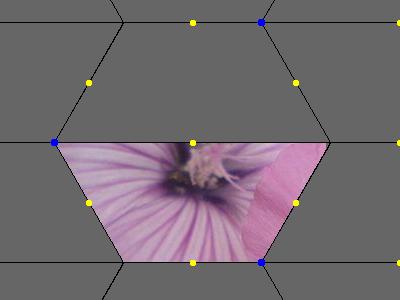
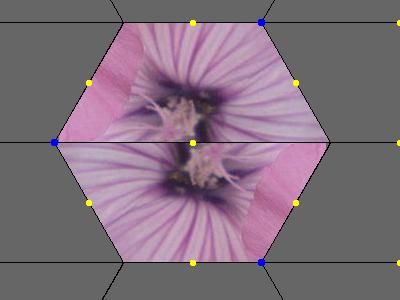
p2: 2222
Four C2 rotations.
Cost: $\frac12+\frac12+\frac12+\frac12=2$
Manifold: sphere
Euler characteristic: χ=2
Chromatic number: 4
|
 |
 |
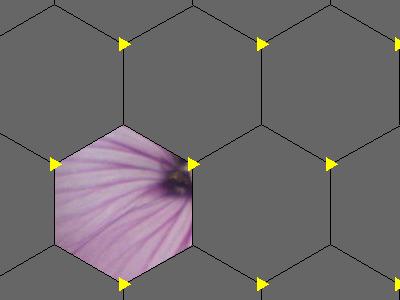
p3: 333
Three C3 rotations.
Cost: $\frac23+\frac23+\frac23=2$
Manifold: sphere
Euler characteristic: χ=2
Chromatic number: 4
|
 |
 |
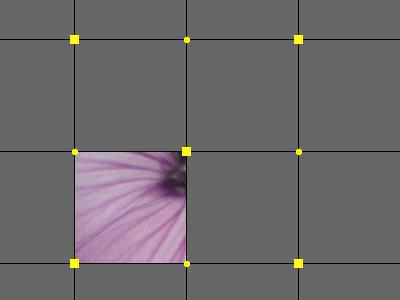
p4: 442
Two C4 rotations and one C2 rotation.
Cost: $\frac34+\frac34+\frac12=2$
Manifold: sphere
Euler characteristic: χ=2
Chromatic number: 4 |
 |
 |
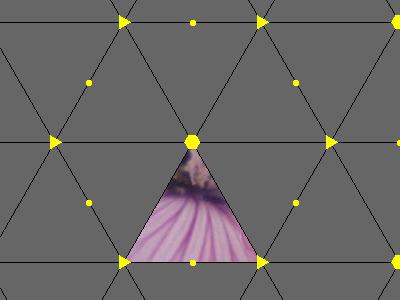
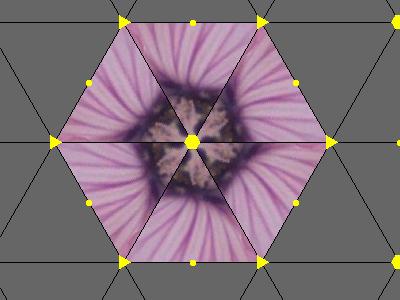
p6: 632
One C6, one C3 and one C2 rotation.
Cost: $\frac5/6+\frac23+\frac12=2$
Manifold: sphere
Euler characteristic: χ=2
Chromatic number: 4 |
 |
 |
| Pure kaleidoscopes |
| These patterns are generated by three or four dihedral rotations.
The edges of the fundamental domain are lines of reflection, giving rise to a boundary
of the orbifold. Hence the underlying manifold is a disk with Euler characteristic, χ=1.
The boundary, *, has a cost of 1 and each n-fold dihedral rotation has a cost of $\frac{n-1}{2n}$.
|
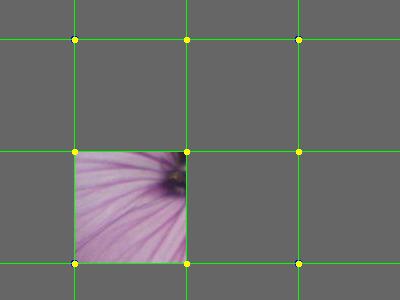
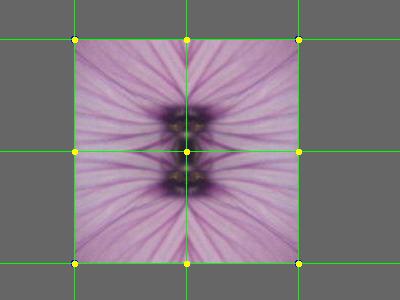
pmm: *2222
One reflection, four D2 rotations.
Cost: $1+\frac14+\frac14+\frac14+\frac14=2$
Manifold: disk
Euler characteristic: χ=1
Chromatic number: 4 |
 |
 |
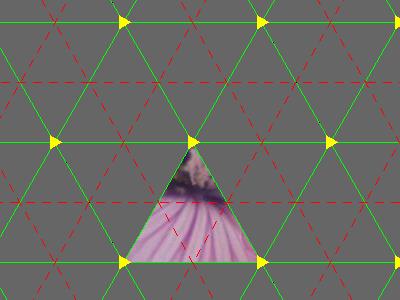
p3m1: *333
One reflection, three D3 rotations.
Cost: $1+\frac26+\frac26+\frac26=2$
Manifold: disk
Euler characteristic: χ=1
Chromatic number: 4 |
 |
 |
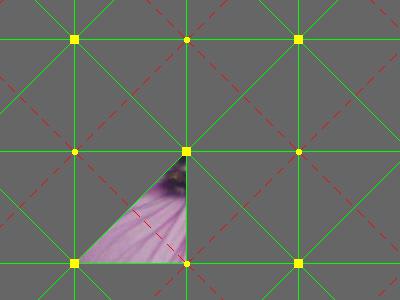
p4m: *442
One reflection, two D4 rotations and one D2 rotation.
Cost: $1+\frac38+\frac38+\frac14=2$
Manifold: disk
Euler characteristic: χ=1
Chromatic number: 4 |
 |
 |
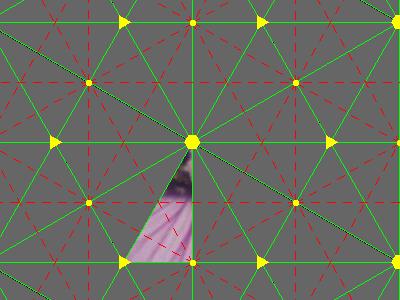
p6m: *632
One reflection, one D6, one D3 and one D2 rotation.
Cost: $1+\frac{5}{12}+\frac26+\frac14=2$
Manifold: disk
Euler characteristic: χ=1
Chromatic number: 4 |
 |
 |
| Parallel reflections |
| This patterns is generated by two parallel reflections and a translation.
Two edges of the fundamental domain are lines of reflection, giving rise to a boundary
of the orbifold, the other two are identified.
Hence the underlying manifold is a cylinder with Euler characteristic, χ=0.
|
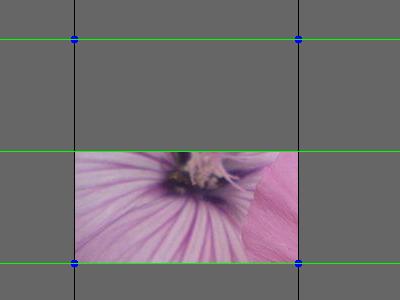
pm: **
Two reflections.
Cost: $1+1=2$
Manifold: cylinder
Euler characteristic: χ=0
Chromatic number: 4 |
 |
 |
| Hybrid types |
| These patterns have both cyclic points, reflections and sometimes dihedral rotations.
The lines of reflection give a boundary
of the orbifold, so the underlying manifold is a disk with Euler characteristic, χ=1.
The cyclic rotations correspond to conical points and the dihedral rotations give corners.
|
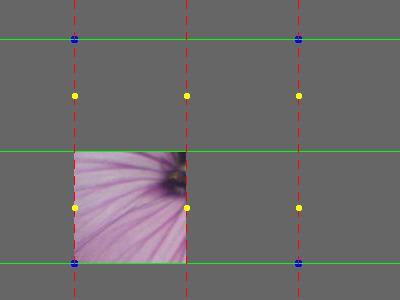
pmg: 22*
Two C2 rotations and one line of reflections.
Cost: $\frac12+\frac12+1=2$
Manifold: disk
Euler characteristic: χ=1
Chromatic number: 4 |
 |
 |
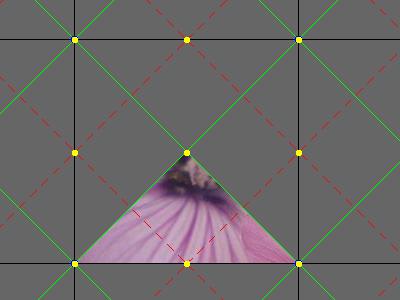
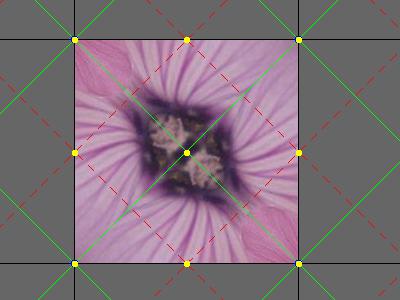
cmm: 2*22
One C2 rotation, one reflection and two D2 reflections.
Cost: $\frac12+1+\frac14+\frac14=2$
Manifold: disk
Euler characteristic: χ=1
Chromatic number: 4 |
 |
 |
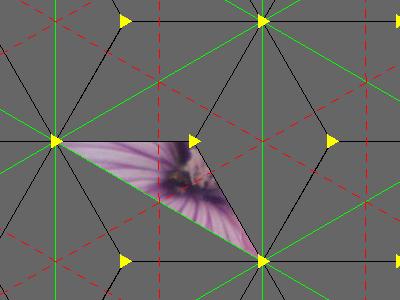
p31m: 3*3
One C3 rotation, one reflection and one D3 rotation.
Cost: $\frac13+1+\frac26=2$
Manifold: disk
Euler characteristic: χ=1
Chromatic number: 4 |
 |
 |
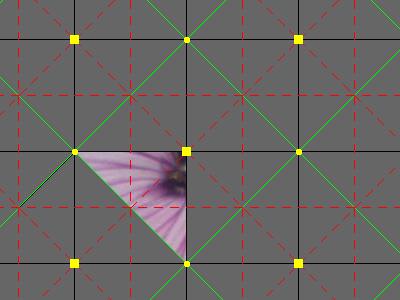
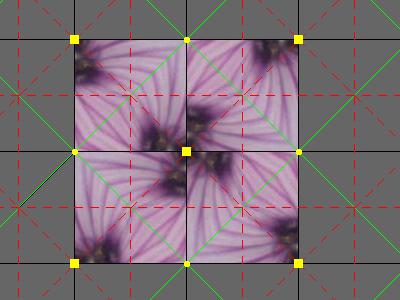
p4g: 4*2
One C4 rotation, one reflections and one D2 rotation.
Cost: $\frac34+1+\frac14=2$
Manifold: disk
Euler characteristic: χ=1
Chromatic number: 4 |
 |
 |
| Glide-reflections and cross-caps |
These patterns all have glide reflections
indicated by a x with cost 1.
Opposite edges are identified in a reverse direction, yielding
non-orientable manifolds.
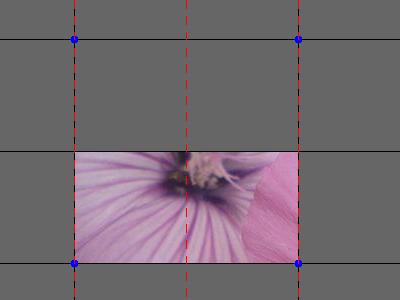
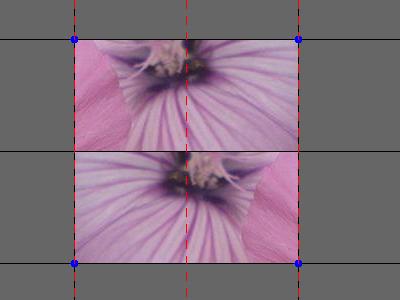
pg: xx
Two parallel glide-reflections.
Cost: $1+1=2$
Manifold: Klein bottle
Euler characteristic, χ=0.
Chromatic number: 6
|
 |
 |
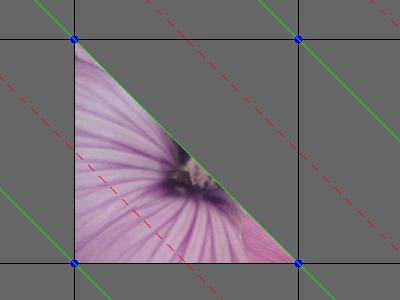
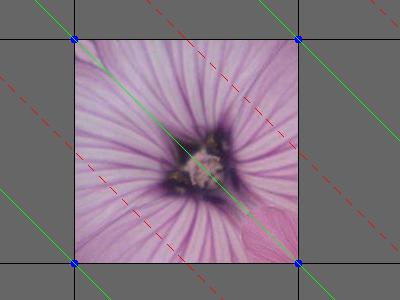
cm: *x
A reflection and a glide-reflections.
Cost: $1+1=2$
Manifold: Möbius band
Euler characteristic: χ=0.
Chromatic number: 6
|
 |
 |
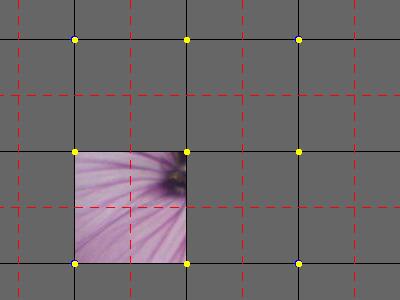
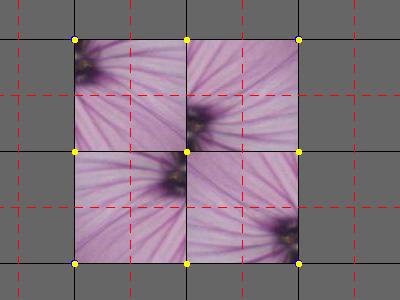
pgg: 22x
Two C2 rotations, and a glide-reflection.
Cost: $\frac12+\frac12+1=2$
Manifold: real-projective plane RP²
Euler characteristic: χ=1.
Chromatic number: 6
|
 |
 |
| The wonder: just translations |
|
This pattern has no additional symmetries.
Opposite edges are identified, so the underlying manifold is a torus with Euler characteristic, χ=0.
|
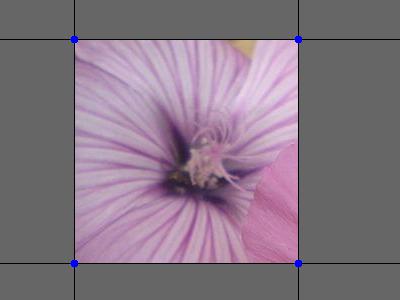
p1: o
Cost: $2$
Manifold: torus
Euler characteristic: χ=0.
Chromatic number: 7
|
 |
 |
Chromatic number for orbifolds and tilings
Given a wallpaper group with a specified lattice, we can consider the
set of tilings that are invariant under the that group.
Similar to the four-colour theorem
for planer graphs we can consider the Chromatic number for the wallpaper group:
The smallest number χ, such that any tiling invariant under the group
can be coloured with χ colours such that:
- No two tiles with the same colour share a common edge
- The colouring is invariant under that tiling
Calculating the chromatic number is easy, it is the
same as the chromatic number of the underlying topological
manifold of the orbifold, and the chromatic numbers
of the each type of manifold are well known -
Torus: 7, Möbius band: 6, Klein bottle: 6, Projective Plane: 6,
sphere: 4, disk: 4, open cylinder or annulus: 4.
All that remains is to find a tiling that achieves the maximum bound.
Again there are well known graphs on the various manifold that achieve
the maximum, so we simply have unwrap these graphs to
form a tiling of the plane. We give examples of each of these
below and discuss how the underlying manifold is derived.
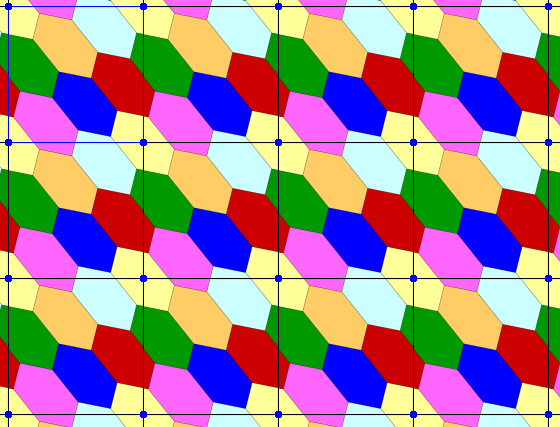
P1, manifold: torus, chromatic number: 7
Given a topological space X and a group G we can form the quotient space
by factoring out the group action. Say with the P1 group
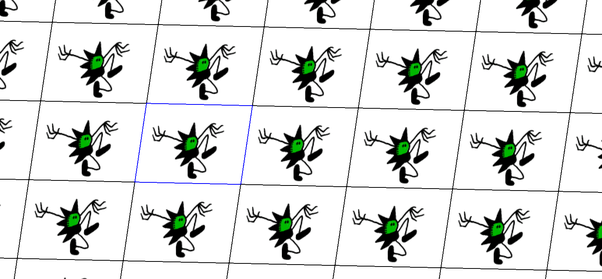
Using a motif of Beanish from Tales of the BeanWorld.
Factoring out the group action generated by the two translations
gives a single cell with opposite edges are identified.

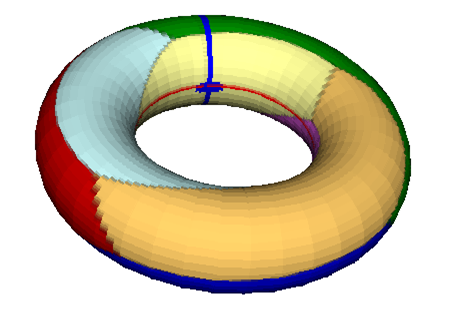
We can wrap the image around a cylinder, so the blue arrows match, and then join the top of the cylinder to the bottom to form a torus:
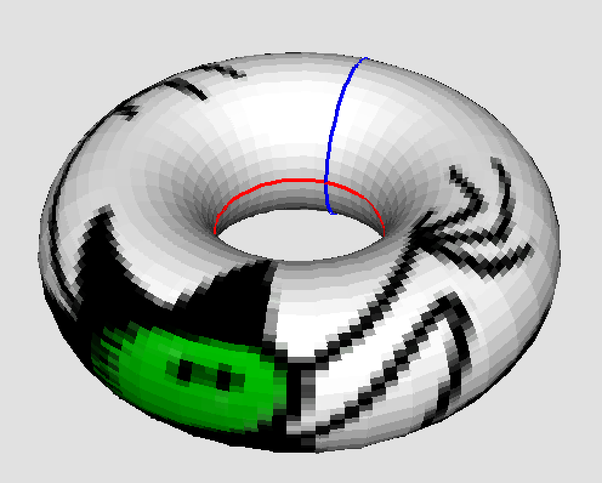
The torus has Euler characteristic χ=0, and following the
Heawood conjecture
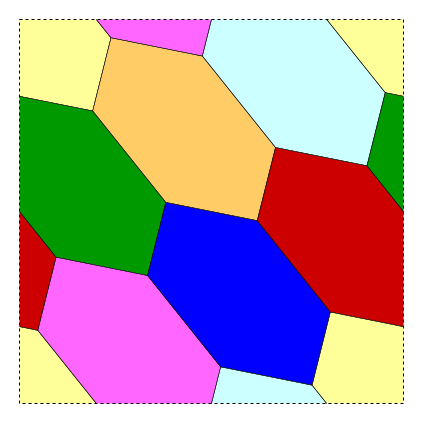
any tiling with this symmetry can be coloured with 7 colours,
so that no two faces of the same colour share an edge.
One such tiling is based on hexagons.
|
|
|
| Unit cell
| Wallpaper pattern
| Wrapped around a torus
|
CM, manifold: Möbius band, chromatic number: 6
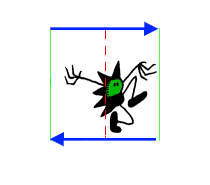
This pattern has a reflections and a parallel glide-reflection.
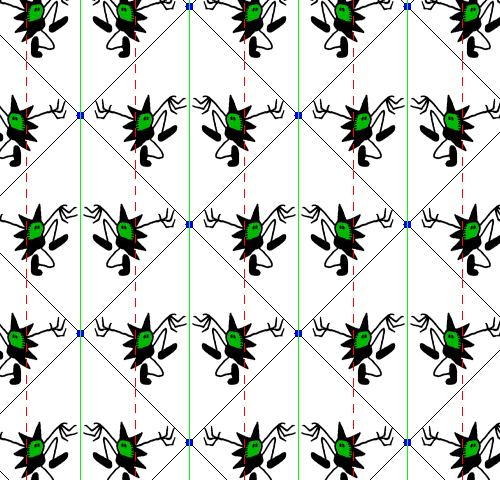
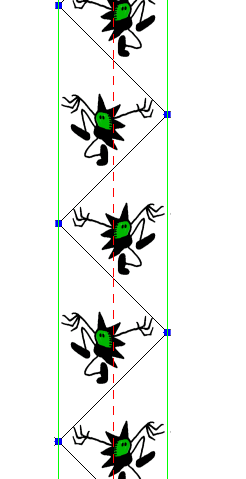
Folding along the reflection lines gives a strip with glide-reflection.
The fundamental domain has top and bottom identified in opposite directions,
and forms a Möbius band.
| 
| 
|
| A strip formed by folding along the reflection lines, has a glide-reflection.
|
The unit cell has top and bottom identified, but in opposite directions:
| Joining edges forms a Möbius band.
|
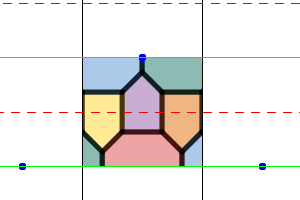
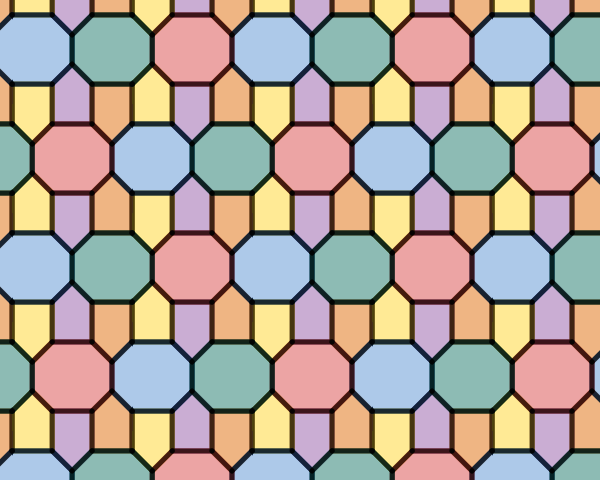
The Euler characteristic of the Möbius band is 0,
and in 1910 Heinrich Tietze found a subdivision into
six mutually adjacent regions. This can be used as the basis of
a tiling of the plane requiring 6 colours.
|
|

|
| Unit cell
| Wallpaper pattern
| Wrapped around a Möbius band
|
PG: xx
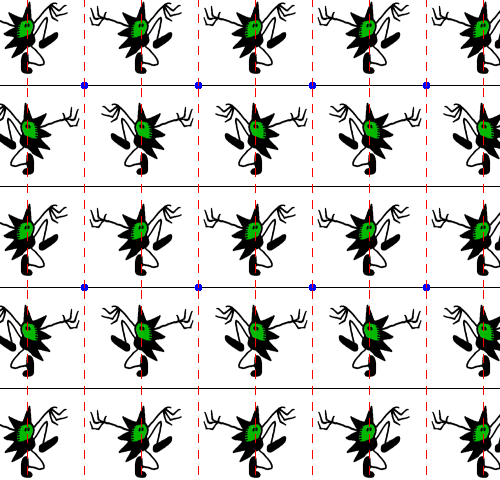
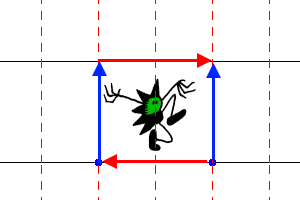
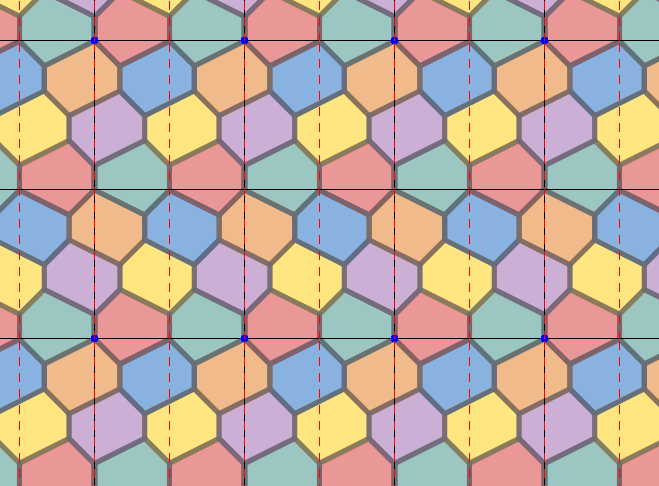
This pattern is generated by two parallel glide reflections.
So the motif is translated in one direction and flipped and translated in the other direction.
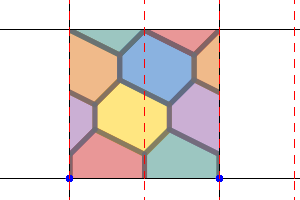
The unit cell has opposite edges identified, one pair with the same
orientation, and the other with reversed orientation.
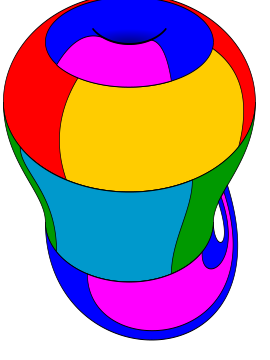
Identifying edges gives a Klein bottle.
| 
|
| Wallpaper pattern
| Unit cell
|
This has Euler characteristic χ=0, and chromatic number 6.
|
|
|
| Unit cell
| Wallpaper pattern
| Wrapped around a Klein Bottle.
(source)
|
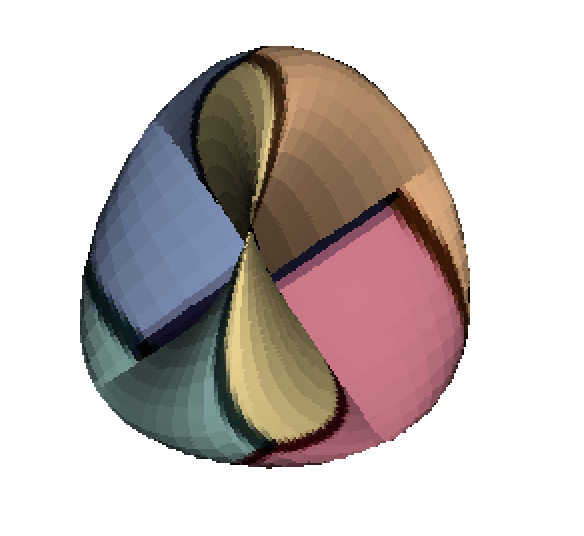
PGG: 22x
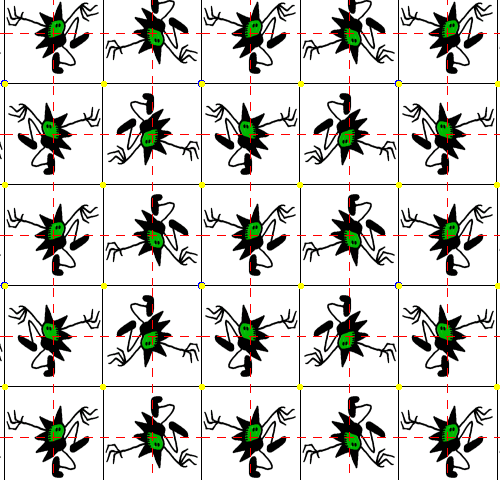
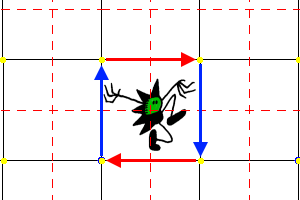
This pattern has two perpendicular glide reflections
and two C2 cyclic rotations.
So the motif is flipped and translated in the both direction.
The unit cell has opposite edges identified, each pair with reversed orientation,
and joining the opposite edges gives a real projective plane.
| 
| 
|
| Wallpaper pattern
| Unit cell
| Wrapped around a real projective plane.
|
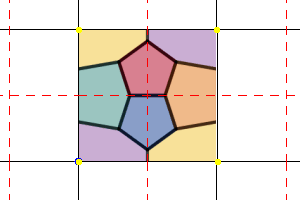
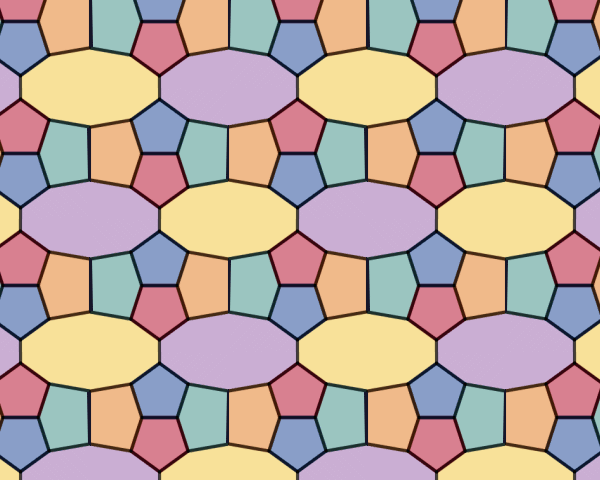
This has Euler characteristic χ=1, and chromatic number 6.
|
|
|
| Unit cell
| Wallpaper pattern
| Wrapped around a Klein Bottle.
|
The cell division here is adapted from
mathcurve.com
PM, manifold: cylinder, chromatic number 4
The PM pattern has two parallel reflections.
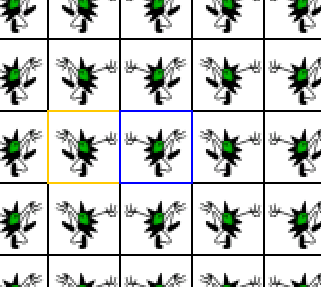
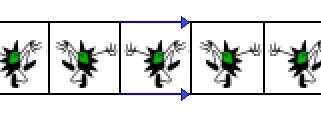
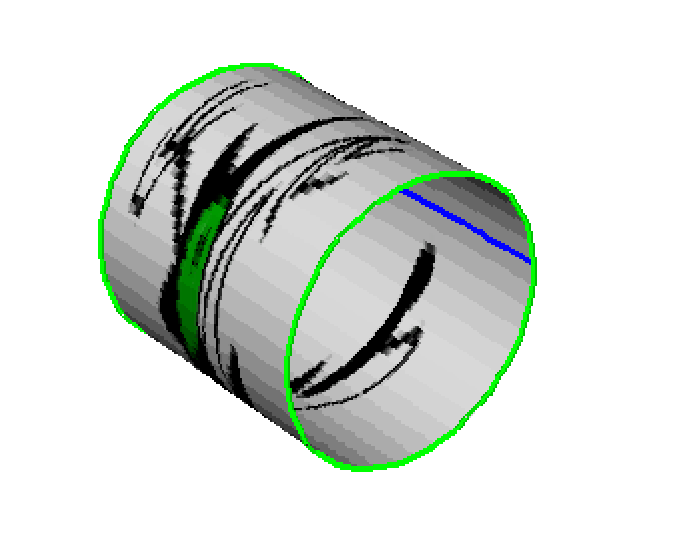
Take a horizontal strip with top and bottom identified,
fold along the vertical mirror lines, forming a concertina.
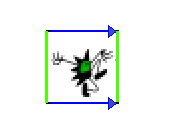
Identify top and bottom edges to form a cylinder. The green edges
correspond to the two lines of reflection, which always form
a boundary on the orbifold.
| 
| 
|
| A strip formed by folding along the reflection lines.
| The unit cell has top and bottom identified, so it forms a cylinder.
| Joining edges forms a cylinder.
|
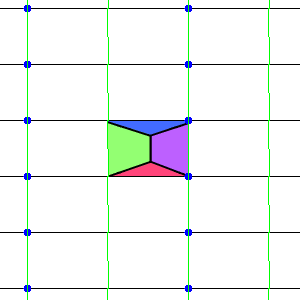
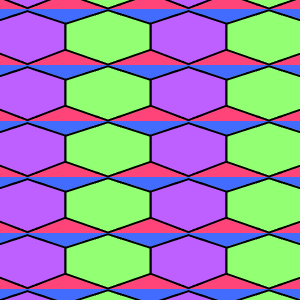
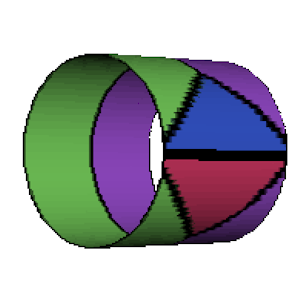
The cylinder has Euler characteristic χ=0, and had chromatic number 4,
so four colours suffice.
| 
| 
|
| Fundamental domain
| Wallpaper pattern
| Orbifold
|
Groups generated by cyclic rotations
In terms of colouring the interesting groups are those with a chromatic number greater than 4 are
shown above. The rest are either topological spheres or disks, and can be coloured with 4 colours.
First we consider the groups generated by cyclic rotations P2 (2222), P3 (333), P4 (442) and P6 (632).
P2, manifold: sphere, chromatic number 4
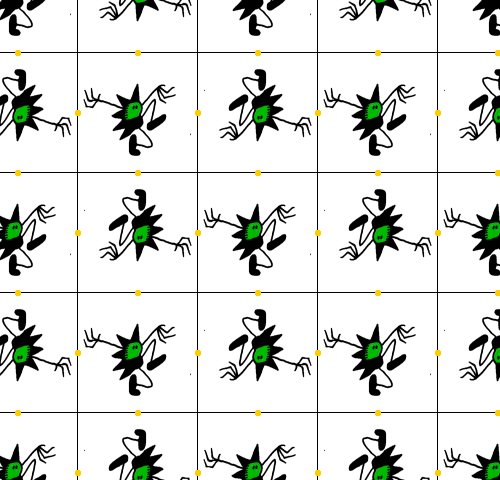
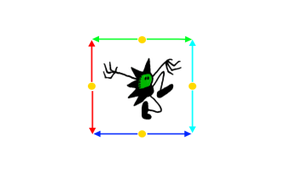
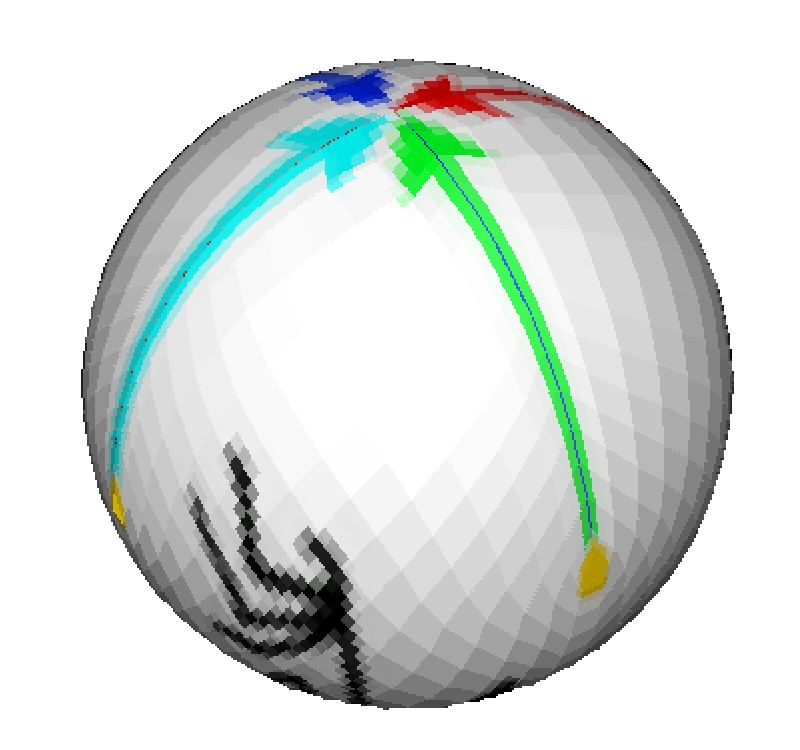
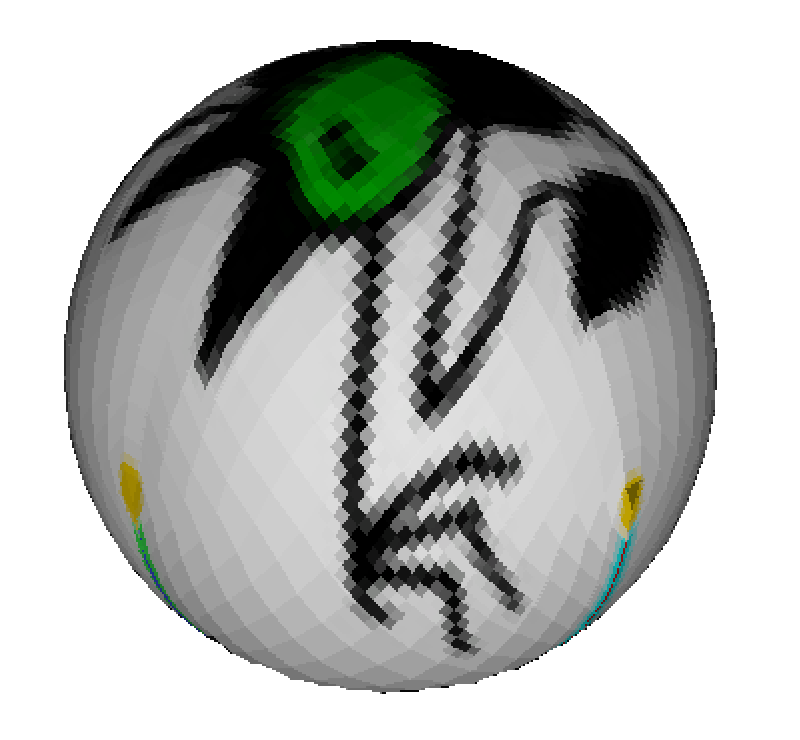
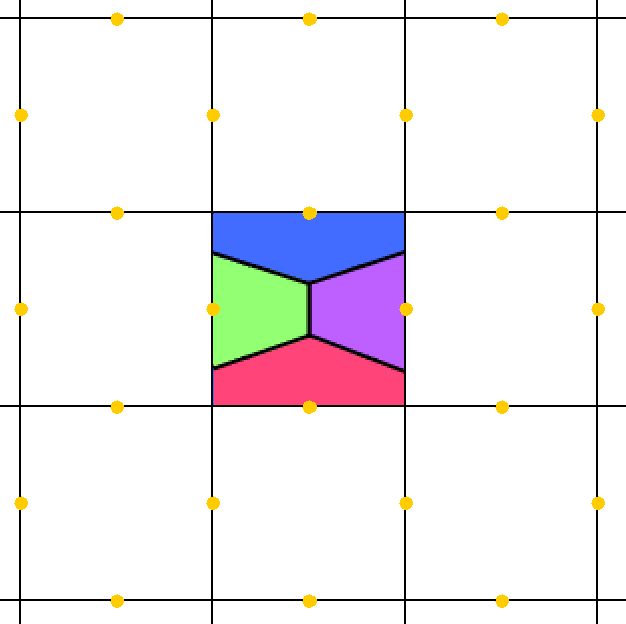
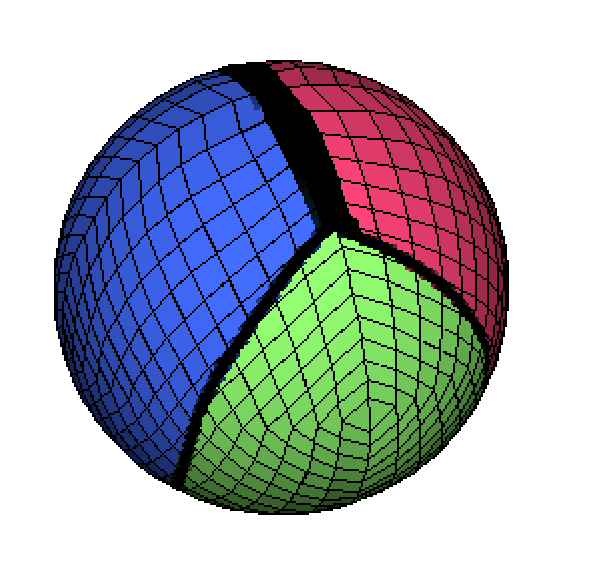
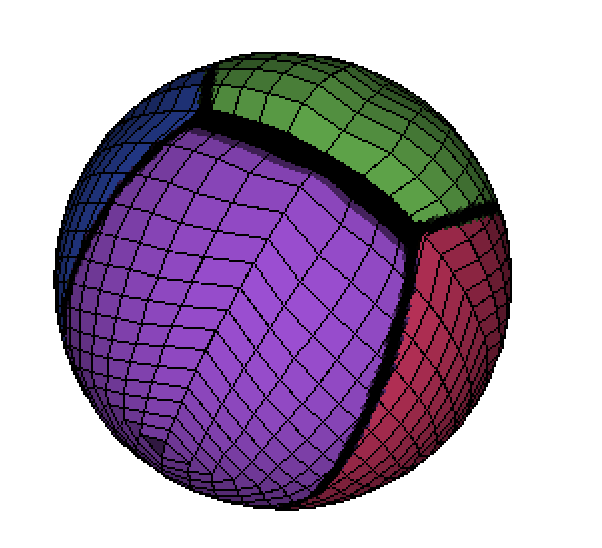
The P2 is generated by four C2 rotations, around the mid-points of
a rectangular fundamental domain. The two halves of each edge
are identified, so the edges join up to form a sphere.
| 
| 
|
| Unit cell
| Top of sphere
| Bottom of sphere
|
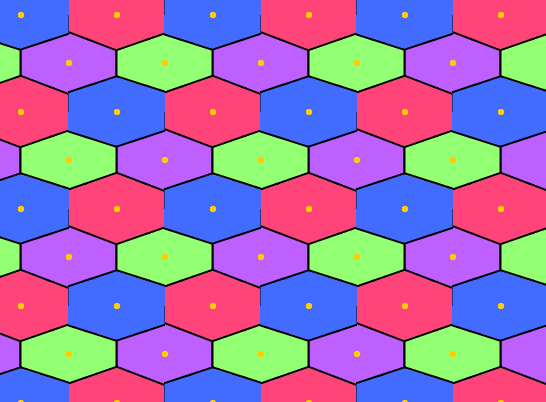
A tessellation requiring 4 colours is easy to find.
Start by considering a tetrahedral polygonization of the sphere, with four
mutually adjacent triangular faces, each of a different colour. Such a polygonization
can be arranged so that each of the four rotation points lie inside one of the four faces.
Next unwrap this to form the fundamental domain, and apply the symmetries to form the tiling.
| 
| 
|
| Unit cell
| Top of sphere
| Bottom of sphere
|
P3, P4, P6
A similar process can be used to the other pure rotational groups, P3, P4 and P6.
In each case the pattern is generated by three rotations. The tiling
is chosen so that each rotation point lies in the centre of a face, the fourth
triangular face is chosen in the middle of the fundamental domain.
Groups generated by dihedral reflections
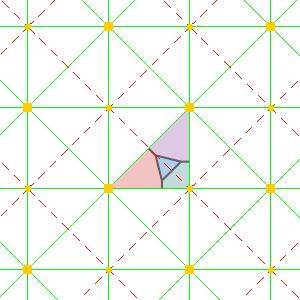
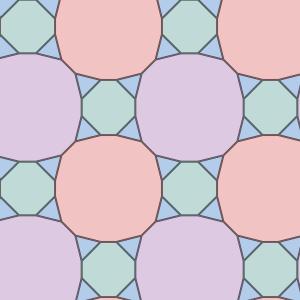
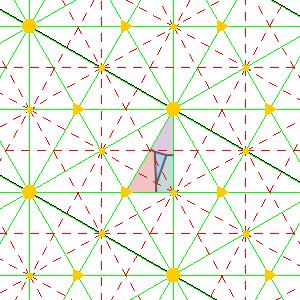
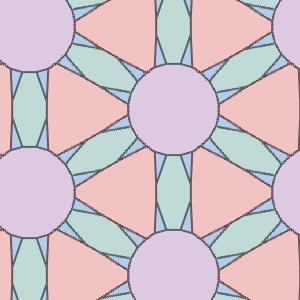
The groups PMM, P3M1, P4M and P6M, are all generated by dihedral rotations.
Each edge of the fundamental domain is a reflection line which form
an edge in the underlying manifold. Hence the manifold is a topological disk
with chromatic number 4.
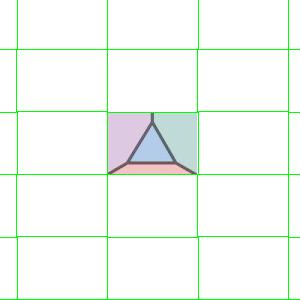
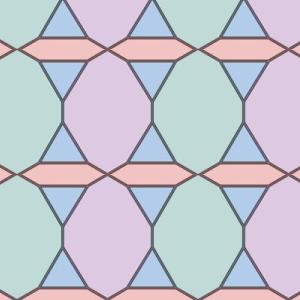
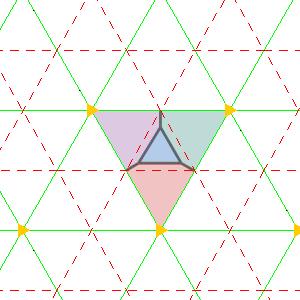
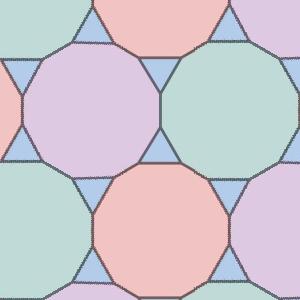
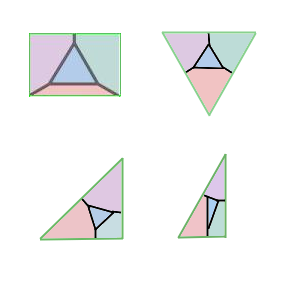
Finding tilings that require four colours is easy here. Take an
domain with a small triangle in the centre and draw lines outward from the
corners. This forms a square or triangle with four mutually adjacent regions.
| 
| 
| 
|
| PMM domain
| PMM wallpaper
| P3M1 domain
| P3M1 wallpaper
|
| 
| 
| 
|
| P4M domain
| P4M wallpaper
| P6M domain
| P6M wallpaper
|
For these groups the orbifold is a polygon corresponding to the fundamental domain,
the reflection lines form the boundary of the orbifold, each dihedral rotation point
giving a vertex. Topologically this is a disk.
|
| Orbifolds for PMM, P3M1, P4M and P6M
|
Mixed types
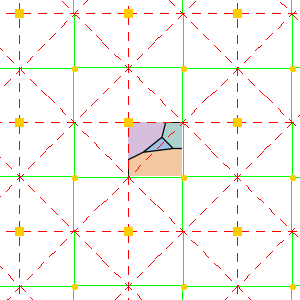
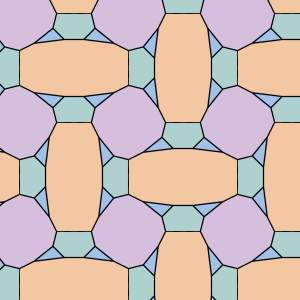
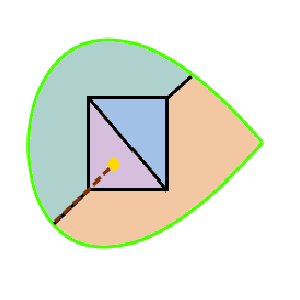
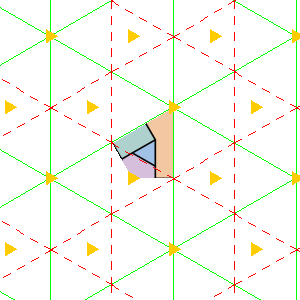
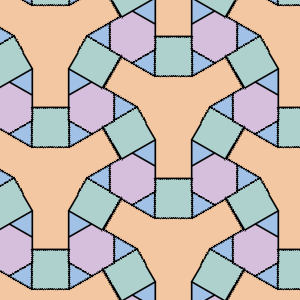
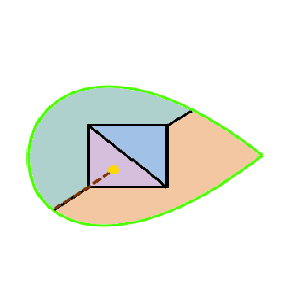
The groups CMM, P31M and P4G all
have both cyclic rotations and dihedral rotations.
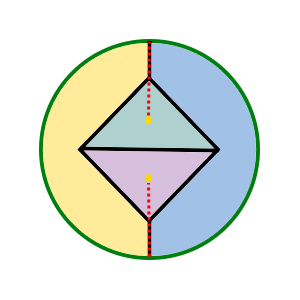
The lines of reflection gives an edge around the underlying manifold,
a topological disk, with corners for each dihedral rotation.
Cyclic rotation points lie in the middle of the disk.
Each pattern has chromatic number 4.
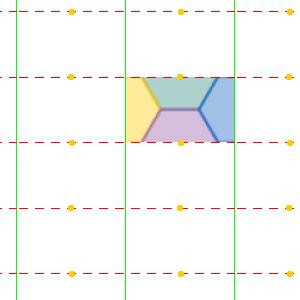
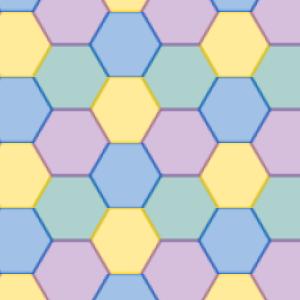
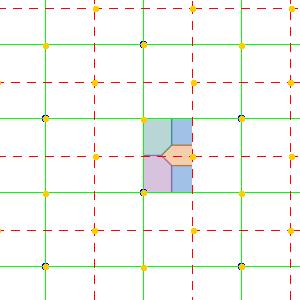
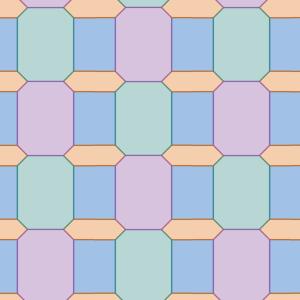
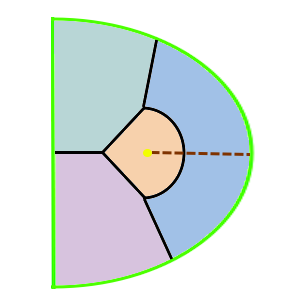
PMG is similar, it has a line of reflection and two cyclic rotation points,
by no dihedral rotations.
| 
| 
| 
| 
| 
|
| PMG domain
| PMG wallpaper
| PMG underlying manifold
| CMM domain
| CMM wallpaper
| CMM underlying manifold
|
| 
| 
| 
| 
| 
|
| P4G domain
| P4G wallpaper
| P4G orbifold
| P31M domain
| P31M wallpaper
|
Summery of colourings
| Groups | type | Underlying manifold | Chromatic number |
| P1 | | | | | Torus | 7 |
| CM | | | | | Möbius band | 6 |
| PG | | | | | Klein bottle | 6 |
| PGG | | | | | Projective plane | 6 |
| PM | | | | | Cylinder | 4 |
| P2 | P3 | P4 | P6 | pure rotation | Sphere | 4 |
| PMM | P3M | P4M | P6M | dihedral rotations | Disk | 4 |
| CMM | PMG | P31M | P4G | mixed | Disk | 4 |
References
Readers comments
Add a comment/link:
SingSurf Home
Wallpaper app Help
Maths
Orbifolds
Groups
Code
Copyright R Morris 2025
|